
Why is the new plastering material gypsum mortar so important in house construction?

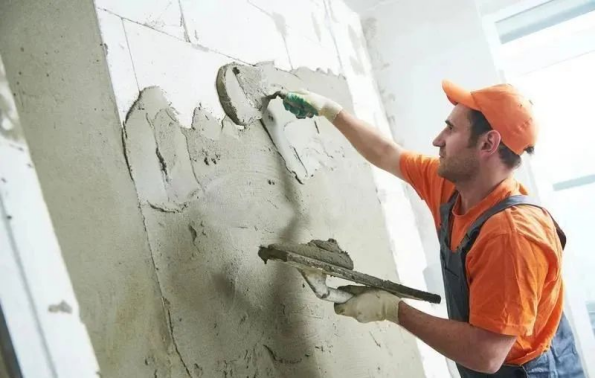
Gypsum mortar refers to a powdered material produced by a professional manufacturer that is a mixture of finely ground aggregates that have been dried and sieved, mineral admixtures and additives that have been mixed with a cementitious material in a certain ratio. On the construction site, it is a powdered material that only needs to be mixed with the specified amount of water and then stirred well before it can be used. Before mixing with water, gypsum mortar is called gypsum mortar mix; after mixing with water and stirring well, it is called gypsum mortar mix; after setting, it is called gypsum mortar hardening body. Gypsum mortar is mixed with a hand-held electric mixer or a continuous mixer for at least 2 minutes. It should be used as soon as it is mixed and should be used within 45 minutes after mixing is complete.
Process flow and on-site verification
1.Experimental conditions In order to verify the plastering effect of gypsum mortar, two rooms were selected in a project in Wuhan for plastering research. The plastering area is about 30 square meters, the construction thickness is controlled at 10-15mm, and the plastering is done in one go by two plastering workers with construction experience. The base layer and on-site conditions have been completed by the general contractor.
2.Experimental process Clean the construction wall and remove dust and debris from the wall surface. Mix the levelling material according to a volume ratio of 1:2 using an electric hammer for about 2 minutes. The mixture should be used within 45 minutes after mixing is complete. Mix the interface agent manually at the same time. Moisten the concrete wall with water and apply the interface agent to the shear wall. Hang alkali-resistant mesh cloth at the junctions between the shear wall and masonry wall, and the beam and masonry (requiring a small hole spacing) to prevent cracking. Use a glass steel reinforcing bar to punch the wall reinforcement, use a laser to determine the thickness of the plaster, and wait about 1 hour for the reinforcement to dry before plastering (you can also punch the reinforcement in advance; according to the experience of workers, you can punch 70 reinforcements a day). Start plastering, and control the thickness of the plaster at 15 mm, but as long as it meets the requirements of the measured results of 4 mm verticality and 4 mm evenness, the thickness of the plaster can be reduced. On site, one person mixes the plaster while another applies it to the wall. The plaster is applied from top to bottom, and the trowel is used from bottom to top. After 1 hour, when the wall is completely dry, the plastering bar is removed, filled in, smoothed and finished. The plastering is complete.
Conclusion
①Gypsum mortar plastering can effectively control hollowing and cracking, and the integrity of the plastered wall is very good, which greatly improves the plastering quality.
②Gypsum mortar plastering can be completed in a single operation, shortening the construction period and allowing for rapid hardening and setting, which can effectively reduce labour costs.
③Gypsum mortar plastering leaves a clean site, with no wet work involved, and a high degree of safety and civilisation.
④The current cost is higher than that of traditional mortar, but with the improvement of mechanisation and the reduction of plastering thickness, plastering thickness can be controlled to within 10mm, which can greatly reduce costs.